Friday, October 22, 2010
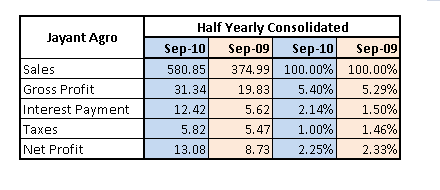
Jayant Agro Half Yearly Results:
Jayant Agro Organics Sept 2010 Half Yearly Results are out.
Please note these are "Consolidated Half Yearly Results 2010 " comparison with "Consolidated Half Yearly Results Sept 2009)
- Sales: 580.85Cr (Last Year: 374.99Cr)
- Gross Profit (PBIT): 31.34Cr (Last Year: 19.83Cr)
- Interest Payment: 12.42Cr (Last Year: 5.62Cr)
- Tax Expenses: 5.82Cr (Last Year: 5.47Cr)
- Net Profit: 13.08Cr (Last Year: 8.73Cr)
Conclusion: Jayant has reported Consolidated Half yearly 54.89% increase in Top line (Sales) and 49.82% in bottom line (Net Profit) as compared to consolidated last year figures..
Gross Profit margin has increased to 5.4% (Last Year 5.29% ).. the net profit is being restricted due to increase in Interest payments 2.14% (Last Year 1.5%)
Jayant Agro has already exceeded the Consolidated Net Profit of year ending March 2010 12.46Cr in 6 months earnings.. We can expect Jayant to report better results for the next 2 Quarters. Full year March 2011 Net Profit could be close to 25Cr (my assumption)
Thursday, October 21, 2010
Sell CALL NIFTY 6100 at 44
Sell NIFTY 6100 CALL at Rs 44 and buyback at Rs1 or less..
Market seems to be tired and looking for a correction.
The Coal India IPO has sucked out a lot of liquidity and this has also coincided with the Future and option expiry for the month ie Thursday Oct 28,2010
The market should remain below 6100 for sure and we can buyback the NIFTY 6100CALL for Rs 1 or less by Thursday Oct 28,2010. this will give us a return of 6.3% in 7 days time on an investment of Rs 30,000
PN: Option trading is a high risk activity please donot invest more than one lot (50 units)
Wednesday, October 20, 2010
Jayant Agro news in Hindu: Oct 20,2010
Article in Hindu about Jayant Agro today Oct 20,2010:
The Vadodra-based Jayant Agro Organics, an oleo chemical manufacturing company, will commence commercial production of Sebacic Acid, a complex value-added castor oil-based derivative at Ihsedu Speciality Chemicals, a joint venture with Mitsui & Co.
Ihsedu Speciality Chemicals, in which Jayant Agro holds 76 per cent equity, will have a capacity to produce 8,000 tonnes a year of sebacic acid and add a turnover of Rs 200 crore, the company said.
Sebacic acid, which is a high margin and value-added specialty chemical, finds application in special grade of nylons, engineering plastics, automobiles coolants etc.
Jayant Agro Organics' wholly-owned subsidiary Ihsedu Agrochem will start co-generation plant based on its by-product de-oiled cake resulting in substantial cost saving, it said. The company also plans to apply for carbon credit as it will be using an eco-friendly fuel. On Tuesday, Jayant Agro shares on the BSE rose one per cent to Rs 140.
Link to the original Post
Friday, October 15, 2010
Jayant Agro Organics: Sept 2010 Shareholding Report and Bonus Chance
Jayant Agro Organics has also reported the shareholding for the quarter ending Sept 30,2010
These are some of the salient points:
- Total number of shareholders: 5,242 (June 2010: 5630)
- HNI shareholding per investor: 32,451 (June: 29,569)
- Small Individual shareholders: 4,709 (June: 5,140)
- Aditya Birla Money has entered into Jayant agro (Nil holding in June 2010): 504,022
CMP: 139.25
Market Cap: 209Cr
The great part is the possibility of bonus which was mentioned in their AGM and recorded in the minutes..
Conclusion: Jayant Agro Organics is a Value buy at these levels cause the company is destined to report higher top line and bottom line growth numbers for the next few years.. This is due to the fact that Jayant Agro is going to move from being a low value added Castor commodities player into a high value added castor derivatives player.. also with peak oil eminent Castor is a replacement product for crude in chemical feed stock.. Strong buy with multibagger opportunities as the company is right now selling at less than one times Quarterly sales.. and this could easily quote at one times sales..
Bonus mention is still not digested by the market.. Next Quarterly results are on Oct 22,2010 so this is as good an opportunity to buy as ever..
Thursday, October 14, 2010
Gujarat Ambuja Exports: Sept 2010 Shareholding Report
Sept 2010 Gujarat Ambuja Exports shareholding data has been published.
Salient points are:
- Promoters shareholding: 88,454,060 (+ve 61,105)
- Institutional shareholding: 6,768,734 (+ve 42,250)
- Individual shareholding: 35,284,376 (+ve 81,642)
- HNI shareholding: 2,701,554 (+ve 366,632)
Shares are being consolidated in a few hands:
The Total number of shareholders has reduced:
No of shareholders in Sept 2010: 56,690
No of shareholders in June 2010: 57,654
Shareholding per High Networth Individual has increased:
Shareholding per HNI Sept 2010: 96,484
Shareholding per HNI June 2010: 93,396
Shareholding per individual is also increasing:
Shareholding per individual Sept 2010: 630.65
Shareholding per individual June 2010: 618.21
DII have also increased shareholding
Reliance Growth fund Sept 2010: 6,286,160
Reliance Growth fund June 2010: 6,238,660
Conclusion: There is still accumulation happening in GAEL Stock which means this is not the price to sell.. we can still accumulate more stock at these levels. Target price for GAEL is 60 and 100
Previous Article: GAEL: Sept Qtr Results report on Oct 23,2010
Next Article: GAEL: Sept 2010 Result Review
Wednesday, October 13, 2010
Gujarat Ambuja Exports: Quaterly results for Qtr ending Sept 2010 on Oct 23,2010
GAEL management has declared the dates for Quaterly results of Quater ending Sept 2010
Board Meeting Date: Oct 23,2010
Purpose: To consider and approve Unaudited (Provisional) Financial Results for the quarter ended September 30, 2010. Further, the Company has informed that the remuneration committee will consider only routine agenda items.
Hold on to your cheap stocks..
Previous Article: GAEL: Hold on To your Cheap Stocks
Next Article: GAEL: Sept 2010: Shareholding Report Review
Tuesday, October 12, 2010
Jayant Agro: Multibagger already recommended as a Best Buy
Jayant Agro was recommended as an investment in May 15,2010 at a price of 81.55.
Current Market Price of Jayant Agro is: 146.70
Jayant in a period of 5 months has given us a return of 80%.
The question in our mind is:
- Is Jayant Agro worth buying at these levels (is it cheap?)
- What is the fair value for Jayant agro Organics.
CMP: 143.70
Market Cap: 215 Cr
Reserves: 71.36Cr
Debt: 165.35Cr
Sales: 886.14Cr [Consolidated March 2010]
Profit Before Depreciation Interest and Tax: 41.04Cr (Consolidated)
Net Profit: 12.63Cr
Enterprise Value: 216.08 + 165.35 - 11.38Cr = 370.05Cr
The stock looks fairly priced.. but we must watch what the management has done.
- Reduced preferential capital worth 3Cr with 7% interest and replaced with additional equity (which basically means promoters expect equity a.k.a stock price to outperform)
- Value added products are being manufactured in 75% subsidiary company with 25% stake by Mitsui.
- Promoters have increased their shareholding by 4.99% in 2009 and additional 2% in 2010 by buying shares from the open market
- Positive media coverage.. management interview in media with forward looking statement of 35% growth for next 2 years.. (Link)
- Positive news flow that Jayant has been awarded with Highest Exporter of Castor seed Extraction for the year 2009-2010 (sept 24,2010)
If one looks at the recent quaterly statement Jayant Agro had
Sales Q1 June 2010: 290.74Cr (Consolidated)
PBDIT: 16.05Cr
Net Profit: 6.04Cr
======================
Year Ending March 2010 (Audited Consolidated):
Sales : 904.55Cr
PBDIT: 41.32Cr
Net Profit: 12.46Cr
======================
In 1 Quarter Jayant has already earned 48.47% of last years earnings.
Extrapolating the earnings of Jayant for Q1 we can expect jayant to have sales over 1200Cr and Net profit of 24Cr which on an equity base of 7.5Cr works out to be
Sales: 1200Cr
PBDIT: 64Cr
Net Profit: 24Cr
EPS: Rs 16
Current Market Cap: 215Cr
======================
Sept 2010 Quaterly results are scheduled to be announced on Oct 22,2010 (so now is the time to Buy.. before the results..)
Conclusion: Jayant is one of the "Best Buy" recommendations we can expect Jayant stock price to grow at least 100% from these levels ie CMP: 143.7 Target Price: 288 Time period: 12-18 months. Personally considering that Jayant is the largest player in India and India exports 90% of all castor in the world and is the largest producer in the world (pls check old blogs link) I expect Jayant to get a premium and have a market cap close to 1200Cr which is 5.58 times current market capitalisation.. time period would be 24 months to 36 months.
Saturday, October 09, 2010
India to Lift ban on Foreign Retail buying of Indian Stocks
This is the heading of a recent article in Bloomberg (link)
Is this about retail participation after all as mentioned in the article?
The Foreign funds have poured in 92 Billion dollars since the doors were opened in 1993 and in the year 2010 itself India has already received a record 22 billion USD till date.
I think its a small step in the bigger scheme of things. The bigger scheme of things is the collapse of the dollar as the reserve currency and the emerging reserve currencies such as Euro, Yuan.
The Rupee is looking to attract a slice of the pie (with backing from certain power brokers..) The yuan has everything running its way except that its not free and China is not free.
What is needed is a country where there is a rule of law ..(Not because law's will be fair to all.. The reason is "LAW" can be influenced .. the rules can be amended as desired by the business men ) Business Men sounds more interesting than "Power Brokers"
Indian Rupee is being setup as a vessel to hold the wealth as dollar enters the lost decade, today's announcement of direct Foreign retail participation (not yet declared ) is to allow the transfer of dollar assets into "Rupee Assets" as the Dollar goes through the turmoil of excesses of the past.
Foreign investment limits have also been increased for Govt and Corporate debt markets. Well some might say this is really good and India has "Arrived"
Far from it .. India has thrown its hat in the ring as a contender .. it has not been declared a winner.
Just like in any good corporate there are always a number of bright ideas with their mentors.. and a corporation would like to have all the brightest ideas on the table.. However there will be a tussle and may the best team win.
One must remember that whether its Team A, Team B, Team C or Team D.. the real winners are the Promoters who own the corporation.. yes the Rupee team might have the satisfaction of being declared the winners .. the adrenaline rush of a good fight. One must not forget.. which ever team wins since the promoters are the same the true winners are the promoters.. (a.k.a Power Brokers, Business Men)
Friday, October 08, 2010
Option Trade: Buy NIFTY 6400CE Back at Rs15 or less making 4.8% in 1 week
On October 3,2010 NIFTY 6400CE was advised for a Sell at Rs50
Right now on Oct 8,2010 the same Call (NIFTY 6400CE) is available at Rs17. It would be advisable to Buyback the Call at Rs15 (after 3.00pm IST) making Rs 35 in one week time frame.. (we should be able to buyback after 3.00pm IST at around Rs15 or lower...)
For one lot of 50 units after expenses profit would be:
Sell Price (Rs50): 50x50-Rs150(transaction cost) = 2350
Buy back Price(Rs15): 15x50+150(Transaction cost) = 900
Profit: 1450
Investment: Rs 30,000
Return: 1450/30000 = 4.8%
Waiting for One more week will give additional Rs5 reduction in buyback price.. but it is adviseable to buyback as we have achieved more than 50% of the target 7.3% return reducing our risk..
Monday, October 04, 2010
One months: Options Trade: Sell 6400CE for 50.00
Since the market seems to have topped out we can make some calculated bet.
I am thinking that NIFTY will not cross 6400 and one can safely sell NIFTY 6400CE at Rs 51.
It will cost approximately 30,000 for 50 units and if the market closes below 6400 by Oct 28,2010 you will make 2200 on your investment ie 7.3% in one month
PN: Options are usually very dangerous because of time value action and please donot invest more than 1 lot ie 50 units.
Saturday, October 02, 2010
Book Review: The Pregnant King - Devdutt Pattanaik
An excellent work of fiction.. I just could not keep it down until read.
"I am not sure that I am a man" said Yuvanashva. "I have created life outside me as men do, but I have also created life inside me, as women do. What does that make me? Will a body such as mine fetter or free me?"
Among the many hundreds of characters who inhabit the Mahabharata perhaps the world's greatest epic and certainly one of the oldest, is Yuvanashva, a childless king, who accidentally drinks a magic potion meant to make his queens pregnant and gives birth to a son. This extraordinary novel is his story.
Is is also the story of his mother Shilavati, who cannot be king because she is a woman; of young Somvat, who surrenders his masculinity to become a wife; of Shikhandi, a daughter brought up as a son ; of Arjuna, the great warrior with many wives, who is forced to masquerade as a woman after being cursed by a nymph; of Ileshwara, a god of full-moon days and a goddess on new moon nights; and of Adi-natha, the teacher of teachers, worshipped as a hermit by some and as an enchantress by others.
Building on Hinduism's rich and complex mythology- but driven by a very contemporary sensibility - Devdutt Pattanaik creates a lush and fecund work of fiction in which the lines are continually blurred between men and women, sons and daughters, husbands and wives, fathers and mothers. Confronted with such fluidity the reader is drawn into Yuvanashva's struggle to be fair to all- those here, those there and all those in between.
====================
Review comments by Sumita:
What intrigued me to buy this book was the name, 'The Pregnant King'. How can a king, a man, become pregnant? Is it at all possible???
This book revolves around the various emotions that surround humans; love, anger, submission to power & desire, helplessness, confusion, jealousy, hunger for power... In this book, emphasis has also been laid on following the right path or 'dharma'.
This book, a work of fiction, revolves around a king named Yuvanashava. How desperately he wants to father a son! It's only after he has a son can he rule his kingdom and ensure his lineage is carried forward. He marries thrice in the need of a son. His mother, Shilavati, till then is the acting 'king' as she wants to be known. She does everything to follow the right path to run the kingdom successfully.
Is Yuvanashava ever able to father a son? Is he able to rule the kingdom? Which of the wives bear him a son?
Readers whose engagement with ancient texts runs along orthodox lines might not be too interested in a modern myth. But in a sense, this book is meant for such readers. At its best, this story is about the imperfection of the human condition and our stubborn refusal to make room for all those in between.
The Pregnant King
Movie: Seven Pounds: Must Watch
Seven Pounds is a great movie. Not easy to forget if you have the patience to see it completely. Sometimes confusing but it all adds up at the end. From the directors of "The Pursuit of Happiness"
here is one of the comments from IMDB:
This movie is one of the best films i have ever watched by far. The direction of the film along with the acting was simply world class. It's an emotional roller-coaster. Yes it is slow, yes it gets a little boring, but whilst your watching the movie your always taking in the story line and my does the movie make up for it in the last 30 minutes when the jigsaw is put together and the full plot is revealed. I think this movie is actually better than The Pursuit Of Happiness which most will know was also a very good film. Will Smith, Rosario Dawson, Woody Harrelson, Michael Ealy and Barry Pepper all deserve awards with there 10 out of 10 performances. This movie for me is a must see, i am still actually getting over the film as it quite simply blew me away.
The Song: Have no Fear
The Song: Something Tells Me I'm into something Good!! (Must listen to the song!!)
You can see the trailer for the movie or watch it online (US only)
The movie could turn people off (unethical) but I think its about the circle of life. Life and Death are part and parcel of life.
Friday, October 01, 2010
Batliboi: Watch and Buy at lower levels.
Batliboi http://www.batliboi.com/
Current Market Price: Rs 35
Market Capitalization: 100.39Cr
Reserves: 31.29Cr
Total Debt: 50.82Cr
Sales March 2010: 98.19Cr
Gross Profit: 3.01Cr
Net Profit: -ve 4.12Cr
Batliboi is one of the oldest engineering companies in India. Its area of operations are Machine Tools division, Textile Air Engineering, Textile Machinery, Air Conditioning, Environmental Engineering, Wind Energy, Motors, International Marketing, Logistics.
Batliboi has in recent years acquired
- Quickmill - A leading manufacturer of large area CNC Gantry and Bridge Milling and Drilling Machines is based in Peterborough, Canada http://www.quickmill.com/
- AESA Air Engineering, SA, France. - is one of the premier global companies in the business of Air Engineering for Textiles, Paper and Tobacco industries http://www.aesa-ae.com/
On first look the company seems to be on a perpetual decline and has been reporting losses for 2009 and 2010 that might just be the case but with 81.73% shareholding by the promoters is there something we are missing.
Consolidated revenues provide some data. Consolidated numbers for Year ending March 2010:
Consolidated Sales: 197.50Cr
PBDIT: 5.58Cr
Net Profit: -ve7.84Cr
Consolidated levels also we donot see the profits.. however cash flows from Operations for year ending March 2010 and March 2009 are positive 12.09Cr and 11.66Cr respectively.
Company does have 24.3Cr worth of Free hold land and 18.50Cr of buildings.
Conclusion: All said and done it is really tough to say Batliboi is a value buy .. but I am looking at the promoters (80+% shareholding) and cash flow (12Cr) of the company which gives me confidence to invest in the Batliboi stock at these levels. Once the company starts reporting profit we can expect Batliboi to quote at 1 times Consolidated Sales which will be close to 300Cr The land bank is something of a bonus ..so right now its a Cigar Butt and we can get a few puffs from this stock. It will however take a 2-3 year horizon to really get some good value from batliboi
PN: These are my personal views and opinion.. please do your own deep dive before investing.
Sunday, September 26, 2010
Gujarat Ambuja Exports: Hold on to your cheap stocks
Gujarat Ambuja started the week on Sept 20,2010 at 30.00 and closed week ending Sept 24,2010 at 35.00 an increase of 16.66% in one week.
GAEL stock also hit a new 52 week high of 35.85 .. one must remember that 35.90 was the circuit limit for Friday Sept 24,2010. The question in our minds is:
1. What is the next step?
2. When do we exit?
The next step for investors who are already invested in GAEL is "HOLD" "HOLD on to your cheap stocks"
To buy GAEL below 38 is the best investment decision made .. now we have to hold on to our emotions and not over trade. I am sure some of you have been trading in and out of GAEL stock. My own personal experience is that trading for short term is not a very successful activity.
Promoters buying generally is for returns greater than 300% so we can be assured that GAEL stock can easily cross 100+ in 12-18 months time frame. The important question is do we have the ability to hold the stock in its journey from 35 to 100? GAEL stock will definitely experience volatility of 30% or more and days when we will be pushed to sell .. Rest assured GAEL stock should not see levels below 30 which would be an excellent opportunity to buy ..
I personally have had bad experience trading stocks for short term.. and would not encourage people to trade short term however as per candle sticks GAEL is a hold ..
Points to be kept in mind:
- GAEL Current Market cap is: 484Cr
- GAEL Year ending March 2010 Gross Profit is 117.50Cr
- GAEL is a company with book value of 30.39 for a share of Rs 2 Face value.
- Long Term Debt is only 13.83Cr
- Average ROCE is strong 14.99% for past 5 years
- Cash in hand of 28.16Cr (March 2010)
- 40Cr worth of quoted securities.
- Promoters are still accumulating stock from the market clearly indicating that the stock is undervalued.
Previous Article: GAEL: Promoters buy 53,506 shares from market in August2010, Annual Report for year 2010
Next Article: GAEL: Sept Qtr Results on Oct 23,2010
Friday, September 24, 2010
Sunrise Senior Living: Interview CEO: SUN Healthcare group
On Sept 20,2010 excerpts from interview of Richard K Matros, CEO, SUN Healthcare Group. I donot have access to the complete transcript I am just looking at the excerpts and thought there are some points which need to be highlighted..
So the company became very healthy. As we did those acquisitions, those acquisitions owned a lot of the real estate. In our business, real estate has really never been a driver of value. In other words, companies in our business tend to be valued on how the business does, how well you execute the business model, because the nursing home business, much like hospitals, is a pretty complex business, with the exception of the 2005 to 2007 period, when the CMBS market was hot and real estate was driving everything.
So for a brief period of time, real estate was driving nursing home transactions for those nursing home companies that owned a significant portion of the real estate. A lot of companies in the business lease most of their assets; every company has a different mix of owned and leased assets. So we were sitting here with a pretty good book of business on the real estate side, and last year I was focusing on how best to monetize that real estate because we never thought we would get value recognition for it. And with the CMBS market turning down along with everything else in the recession, we really looked at that as a blip. We don't believe real estate on a go-forward basis will be a driver for our sector, as it hasn't been for the last 30 years. Also from a timing perspective, because of the recession, and even though we have been acquisitive by nature, there just hasn't been much product out there; there has been really nothing to buy. So it gave us an opportunity to look at other ways to enhance shareholder value. We focused on the real estate, we focused on how best to monetize the real estate, at the same time making sure that the operating company would be as healthy on a go-forward basis as it was today so that anything we did to monetize that real estate wouldn't impair the operating company's ability to grow. Once we satisfied ourselves that that would be the case, we focused on the best way, again, to monetize the real estate. Our determination was that the best way was to essentially break the company into two publicly held companies, one being a health care REIT and one being an operating company.
I dont know if I have got it all wrong.. but the CEO of SUN Healthcare Group is quite confident that Healthcare companies get valued for how the business does, how well you execute the business model and not on the real estate that is held by the company. The CEO of SUN Healthcare believes real estate on a go-forward basis will NOT be a driver for healthcare sector, as it hasn't been for the last 30 years.
SRZ has always believed in not owning the real estate. It has always been proactive in having Venture partners and is focussed on management of properties and brand building. I am certain leasing a property provides a lot of tax benefits. I see the SUNHealthcare CEO statement as a confirmation of the steps taken by SRZ in repairing its balance sheet. Once the debt is out of the books SRZ will be lean, mean and attractive.
Please note these are my personal views based on pubicly available information link to excerpts from the interview
Tuesday, September 14, 2010
Decoding Lakshmi By: Dr. Devdutt Pattanaik
Dr. Devdutt Pattanaik is a medical doctor by education, a leadership consultant by profession, and a mythologist by passion. He has written and lectured extensively on the nature of sacred stories, symbols and rituals and their relevance in modern times.
Website: http://devdutt.com/
Here is one of the interesting articles from the same website. Basically what was interesting was the concept that Conflict between "Devas" and "Asuras" is not a struggle between the "Good" and "Evil" but it is a fertility cycle. I dont think I would do justice to the article it is best if you read the article itself..here is the article.
A bowl of rice will provide equal satisfaction to a rich man and a poor man, to a saint and a sinner. A bowl of rice does not judge the person who consumes it. The same applies to a piece of cloth. A piece of cloth will provide comfort to whosoever drapes it, man or woman, irrespective of caste, creed or religion. And a house will provide the same quality of shelter to all, without any discrimination. We may judge a bowl of rice, a piece of cloth or a house, but the rice, the cloth and the house will never judge us. For rice, cloth and house are forms of Lakshmi, the goddess of wealth.
It annoys us to find Lakshmi with people we don’t like, people who deem to be criminals and sinners. We believe that Lakshmi should abandon amoral and perverse people. But there she is, with them, and we find it exasperating, irritating and so unfair. In mythology, all villains seem to be rich. Ravan lived in the city of gold and Duryodhan lived like a king till the day he died. Contrast this with Ram who had to live, for no fault of his, in the forest for fourteen years and the Pandavas who were born in the forest and had to live in the forest, in abject poverty, for most of their lives. Why is it so? Does Lakshmi like bad people? Or is she just indifferent to the notions of ethics and morals and propriety and virtue that matter so much to us?
Ancient Indian seers spent a lot of time contemplating on the nature of wealth. And they compiled this knowledge through the stories, symbols and rituals of Lakshmi. Laskhmi embodies the principles of artha, economic and political activity. She is one of the four goals of life, said the seers, the other three goals being: dharma, social order; kama, pleasurable pursuits; and moksha, spiritual practice.
Some scriptures say that Lakshmi follows Vishnu who is the upholder of dharma and her son is Kamadeva, the god of pleasure. Is that wishful thinking? After all, Lakshmi is often seen in the company of with Vishnu’s enemies – the demonic Asuras who city located under the earth was called Hiranyapura, the city of gold, that precious metal so closely associated with Lakshmi. And everyone knows that Lakshmi’s arrival need not always be pleasurable. Her arrival is followed by quarrels and strife. So what is this mystery?
To understand Lakshmi, we have to understand where wealth comes from. Wealth in its most primal form comes from under the ground. Plants come from under the ground. Minerals come from under the ground. Water comes from under the ground. Even petrol comes from under the ground. Lakshmi is therefore called Patala-nivasini, she who resides in the subterranean realm. Patala is also the realm inhabited by the Asuras. The king of the Asuras is called Puloman, and his guru is Shukra of the Bhargava clan. And this brings us to two names of Lakshmi – Pulomi and Bhargavi, which means daughter of Puloman, and daughter of Bhrigu, daughter of the demons and/or their guru! It makes sense, since wealth comes from under the ground, she owes her origin to those who rule the realm under (tala) our feet (pa). In some scriptures, Lakshmi is called Varuna’s daughter, Varuna being the god of the sea. Varuna, incidentally, is also addressed as Asura in Vedic texts. Asura applied to all forces that that locked wealth. The sea locks wealth, the subterranean realm realms lock wealth, trees lock wealth – until it is harnessed and released. Those who release this wealth were called Devas. And Devas lived above the ground as fire (Agni), wind (Vayu), sun (Surya), moon (Chandra) and rain (Indra).
Children’s books often translate the word Asura as demons. And the word demon has a moral judgment. But this moral judgment is missing in Indian literature. Asuras are the children of Brahma, just like Devas. The two sets of beings have different mothers. Diti is the mother of Asuras and Aditi is the mother of Devas. The former live under the ground and the later live above the ground. The former create wealth while the latter yank her out. This makes Lakshmi, Asura-putri (daughter of Asuras) and Deva-patni (wife of the Devas). Indra’s consort, Sachi, is a form of Lakshmi.
Equating Asuras with demons is a legacy of early European scholars, blindly adopted by later Indian academicians. Since Asuras were enemies of Devas, and since Devas were worshipped and hence considered gods, Asuras became demons, a natural conclusion for people who were obsessed with force fitting everything into the binary framework of good and evil.
The reason why Devas were worshipped was not moral, it was material; they released wealth and made it available to all – they released rain from clouds, trees from seeds, water from earth, metals from rocks. Asuras were not worshiped because they hoarded wealth, locked it away from humans. They had to be killed if Lakshmi had to be released. The sun-god’s sunlight, wind-god’s air and the rain-god’s water makes the plants come out. The fire-god’s heat released metal from rocks. Without violence, wealth could not be secured: field has to be ploughed, crops had to be cut, grains had to be threshed, rocks had be broken and smelted….in other words, ‘war’ had to be declared on Asuras and their daughter had to be taken forcibly.
Indra and the Devas live a life of luxury surrounded by wine and women and music and dance. Indra is very blessed. Unlike humans who have to work for a living he can get anything he desires by simply wishing for it for in his realm, Amravati, exists the wish-fulfilling tree, Kalpataru, wish-fulfilling cow, Kamadhenu, and wish-fulfilling gem, Chintamani, and even the elixir of immortality, Amrita. That is why Indra’s abode is called Swarga or paradise. Still Indra is extremely insecure. He fears he will lose his wealth. For unlike Asuras, he does not know how to create wealth; he can only procure and distribute wealth. A sage’s curse can cause Lakshmi to leave his side in an instant. And this invariably happens, no thanks to the megalomania stirred by wealth.
Once again Indra leads the Devas to fight and kill the Asuras and get Lakshmi back. The Asuras can keep creating Lakshmi because they are blessed with something the gods do no possess – Sanjivani Vidya, the secret of regeneration. This can bring the dead back to life, in other words make the barren land fertile. This is a gift obtained for the Asuras by their guru, Shukra, a devotee of Shiva. So the Asuras keep generating wealth and the Devas keep snatching wealth away from them. Which is why every here during harvest times we narrate stories of demons being killed – in Dassera Mahish-Asura is killed by Durga; in Diwali, Narak-Asura is killed by Krishna and in Onam, Bali-Asura is killed by Vaman.
The battle of Devas and Asuras is the battle between spenders and hoarders, distributors and creators. It begins with defeat of Devas and the loss of Lakshmi and ends with victory of Devas and return of Lakshmi. That it is never-ending indicates it is not a battle of good over evil. It is a fertility cycle.
The funny thing is, neither the Devas nor the Asuras are happy. They try hard to hold on Lakshmi but she slips away. In folk tradition Lakshmi is described as being squint – one never knows where she is actually going. She is also called Chanchala, the whimsical one, eternally restless. They say one should never keep the image of Lakshmi standing in the house; she will get tired and run away. One is advised to keep images of Lakshmi comfortable seated, preferably next to Saraswati, goddess of knowledge.
While Lakshmi brings prosperity into a household, Saraswati brings peace. The two goddesses are described as quarrelling sisters. Lakshmi loves to go places where Saraswati resides. But her arrival marks the end of wisdom and peace. With wealth comes quarrels, bickering over money-matters, annoying Saraswati who runs away, which is why they say prosperity and peace rarely coexist. The only god who can bring them together is Ganesha. In some scriptures, he is described as their brother. In others, Lakshmi and Saraswati are forms of Riddhi and Siddhi, wives of Ganesha.
Typically everyone chases Lakshmi. As for Lakshmi, she is drawn to only one god, Vishnu, who is not a Deva, but greater than all Devas, who is actually God (spelt with an upper case) or Bhagavan. Vishnu is the only one who got the Devas and Asuras to cooperate serve as the force and counterforce of a churn that got Lakshmi and other magical treasures to rise from the ocean of milk.
Vishnu is typically shown siding with the Devas. He offers them Amrita, nectar of immortality only to the Devas and he fights alongside them in the battles against Asuras. This seems unfair until one steps back and observes Vishnu’s role as preserver.
Brahma, as creator of both Devas and Asuras sides with both of them equally. Shiva as destroyer is indifferent to both Devas and Asuras and will give both of them equal power. This equality does not result in movement or dynamism; it produces a stagnant destructive statement. Vishnu creates an imbalance that causes the forces of the cosmos to flow, for day to follow night, summer to follow winter. He balances the Sanjivani Vidya given to Asuras by Shiva with Amrita which is reserves only for the Devas. So while one group can regenerate themselves after being killed, the other group is immortal. One groups keeps dying and being reborn while the other group stays alive forever. When the Asuras are killed, the Devas win and Lakshmi is with them. When the Asuras are brought back to life by Shukra, the Devas lose and Lakshmi is back with her fathers.
While Indra seeks Lakshmi for himself, Vishnu does not. Vishnu seeks to create order in the cosmos by the rhythm of nature and order in society by rules and regulations. The story goes that when the earth complained that the kings of the earth were plundering her wealth in greed, Vishnu promised her to take care of her by instituting the code of civilized conduct known as dharma. The earth turned into a cow and Vishnu became her cowherd and caretaker, Gopala. He protected her with dharma and she, in exchange, gave artha and kama.
Dharma is all about balance – taking only as much as one needs, and sharing the excess. Parashurama kills Kartaviryarjuna who steals the cows is given as gifts to sages. Ram kills Ravan who disregards the laws of marriage. Krishna kills the Kauravas who are unable to share wealth with their own family. This makes Vishnu a deity intent on making the world a better place. Perhaps that is why Lakshmi sits coyly at his feet. He is Shrinivas, the eternal abode Lakshmi.
It is something worth sharing.. I always have problem locating the original article. The link to the original article: http://devdutt.com/decoding-lakshmi/
Website: http://devdutt.com/
Here is one of the interesting articles from the same website. Basically what was interesting was the concept that Conflict between "Devas" and "Asuras" is not a struggle between the "Good" and "Evil" but it is a fertility cycle. I dont think I would do justice to the article it is best if you read the article itself..here is the article.
A bowl of rice will provide equal satisfaction to a rich man and a poor man, to a saint and a sinner. A bowl of rice does not judge the person who consumes it. The same applies to a piece of cloth. A piece of cloth will provide comfort to whosoever drapes it, man or woman, irrespective of caste, creed or religion. And a house will provide the same quality of shelter to all, without any discrimination. We may judge a bowl of rice, a piece of cloth or a house, but the rice, the cloth and the house will never judge us. For rice, cloth and house are forms of Lakshmi, the goddess of wealth.
It annoys us to find Lakshmi with people we don’t like, people who deem to be criminals and sinners. We believe that Lakshmi should abandon amoral and perverse people. But there she is, with them, and we find it exasperating, irritating and so unfair. In mythology, all villains seem to be rich. Ravan lived in the city of gold and Duryodhan lived like a king till the day he died. Contrast this with Ram who had to live, for no fault of his, in the forest for fourteen years and the Pandavas who were born in the forest and had to live in the forest, in abject poverty, for most of their lives. Why is it so? Does Lakshmi like bad people? Or is she just indifferent to the notions of ethics and morals and propriety and virtue that matter so much to us?
Ancient Indian seers spent a lot of time contemplating on the nature of wealth. And they compiled this knowledge through the stories, symbols and rituals of Lakshmi. Laskhmi embodies the principles of artha, economic and political activity. She is one of the four goals of life, said the seers, the other three goals being: dharma, social order; kama, pleasurable pursuits; and moksha, spiritual practice.
Some scriptures say that Lakshmi follows Vishnu who is the upholder of dharma and her son is Kamadeva, the god of pleasure. Is that wishful thinking? After all, Lakshmi is often seen in the company of with Vishnu’s enemies – the demonic Asuras who city located under the earth was called Hiranyapura, the city of gold, that precious metal so closely associated with Lakshmi. And everyone knows that Lakshmi’s arrival need not always be pleasurable. Her arrival is followed by quarrels and strife. So what is this mystery?
To understand Lakshmi, we have to understand where wealth comes from. Wealth in its most primal form comes from under the ground. Plants come from under the ground. Minerals come from under the ground. Water comes from under the ground. Even petrol comes from under the ground. Lakshmi is therefore called Patala-nivasini, she who resides in the subterranean realm. Patala is also the realm inhabited by the Asuras. The king of the Asuras is called Puloman, and his guru is Shukra of the Bhargava clan. And this brings us to two names of Lakshmi – Pulomi and Bhargavi, which means daughter of Puloman, and daughter of Bhrigu, daughter of the demons and/or their guru! It makes sense, since wealth comes from under the ground, she owes her origin to those who rule the realm under (tala) our feet (pa). In some scriptures, Lakshmi is called Varuna’s daughter, Varuna being the god of the sea. Varuna, incidentally, is also addressed as Asura in Vedic texts. Asura applied to all forces that that locked wealth. The sea locks wealth, the subterranean realm realms lock wealth, trees lock wealth – until it is harnessed and released. Those who release this wealth were called Devas. And Devas lived above the ground as fire (Agni), wind (Vayu), sun (Surya), moon (Chandra) and rain (Indra).
Children’s books often translate the word Asura as demons. And the word demon has a moral judgment. But this moral judgment is missing in Indian literature. Asuras are the children of Brahma, just like Devas. The two sets of beings have different mothers. Diti is the mother of Asuras and Aditi is the mother of Devas. The former live under the ground and the later live above the ground. The former create wealth while the latter yank her out. This makes Lakshmi, Asura-putri (daughter of Asuras) and Deva-patni (wife of the Devas). Indra’s consort, Sachi, is a form of Lakshmi.
Equating Asuras with demons is a legacy of early European scholars, blindly adopted by later Indian academicians. Since Asuras were enemies of Devas, and since Devas were worshipped and hence considered gods, Asuras became demons, a natural conclusion for people who were obsessed with force fitting everything into the binary framework of good and evil.
The reason why Devas were worshipped was not moral, it was material; they released wealth and made it available to all – they released rain from clouds, trees from seeds, water from earth, metals from rocks. Asuras were not worshiped because they hoarded wealth, locked it away from humans. They had to be killed if Lakshmi had to be released. The sun-god’s sunlight, wind-god’s air and the rain-god’s water makes the plants come out. The fire-god’s heat released metal from rocks. Without violence, wealth could not be secured: field has to be ploughed, crops had to be cut, grains had to be threshed, rocks had be broken and smelted….in other words, ‘war’ had to be declared on Asuras and their daughter had to be taken forcibly.
Indra and the Devas live a life of luxury surrounded by wine and women and music and dance. Indra is very blessed. Unlike humans who have to work for a living he can get anything he desires by simply wishing for it for in his realm, Amravati, exists the wish-fulfilling tree, Kalpataru, wish-fulfilling cow, Kamadhenu, and wish-fulfilling gem, Chintamani, and even the elixir of immortality, Amrita. That is why Indra’s abode is called Swarga or paradise. Still Indra is extremely insecure. He fears he will lose his wealth. For unlike Asuras, he does not know how to create wealth; he can only procure and distribute wealth. A sage’s curse can cause Lakshmi to leave his side in an instant. And this invariably happens, no thanks to the megalomania stirred by wealth.
Once again Indra leads the Devas to fight and kill the Asuras and get Lakshmi back. The Asuras can keep creating Lakshmi because they are blessed with something the gods do no possess – Sanjivani Vidya, the secret of regeneration. This can bring the dead back to life, in other words make the barren land fertile. This is a gift obtained for the Asuras by their guru, Shukra, a devotee of Shiva. So the Asuras keep generating wealth and the Devas keep snatching wealth away from them. Which is why every here during harvest times we narrate stories of demons being killed – in Dassera Mahish-Asura is killed by Durga; in Diwali, Narak-Asura is killed by Krishna and in Onam, Bali-Asura is killed by Vaman.
The battle of Devas and Asuras is the battle between spenders and hoarders, distributors and creators. It begins with defeat of Devas and the loss of Lakshmi and ends with victory of Devas and return of Lakshmi. That it is never-ending indicates it is not a battle of good over evil. It is a fertility cycle.
The funny thing is, neither the Devas nor the Asuras are happy. They try hard to hold on Lakshmi but she slips away. In folk tradition Lakshmi is described as being squint – one never knows where she is actually going. She is also called Chanchala, the whimsical one, eternally restless. They say one should never keep the image of Lakshmi standing in the house; she will get tired and run away. One is advised to keep images of Lakshmi comfortable seated, preferably next to Saraswati, goddess of knowledge.
While Lakshmi brings prosperity into a household, Saraswati brings peace. The two goddesses are described as quarrelling sisters. Lakshmi loves to go places where Saraswati resides. But her arrival marks the end of wisdom and peace. With wealth comes quarrels, bickering over money-matters, annoying Saraswati who runs away, which is why they say prosperity and peace rarely coexist. The only god who can bring them together is Ganesha. In some scriptures, he is described as their brother. In others, Lakshmi and Saraswati are forms of Riddhi and Siddhi, wives of Ganesha.
Typically everyone chases Lakshmi. As for Lakshmi, she is drawn to only one god, Vishnu, who is not a Deva, but greater than all Devas, who is actually God (spelt with an upper case) or Bhagavan. Vishnu is the only one who got the Devas and Asuras to cooperate serve as the force and counterforce of a churn that got Lakshmi and other magical treasures to rise from the ocean of milk.
Vishnu is typically shown siding with the Devas. He offers them Amrita, nectar of immortality only to the Devas and he fights alongside them in the battles against Asuras. This seems unfair until one steps back and observes Vishnu’s role as preserver.
Brahma, as creator of both Devas and Asuras sides with both of them equally. Shiva as destroyer is indifferent to both Devas and Asuras and will give both of them equal power. This equality does not result in movement or dynamism; it produces a stagnant destructive statement. Vishnu creates an imbalance that causes the forces of the cosmos to flow, for day to follow night, summer to follow winter. He balances the Sanjivani Vidya given to Asuras by Shiva with Amrita which is reserves only for the Devas. So while one group can regenerate themselves after being killed, the other group is immortal. One groups keeps dying and being reborn while the other group stays alive forever. When the Asuras are killed, the Devas win and Lakshmi is with them. When the Asuras are brought back to life by Shukra, the Devas lose and Lakshmi is back with her fathers.
While Indra seeks Lakshmi for himself, Vishnu does not. Vishnu seeks to create order in the cosmos by the rhythm of nature and order in society by rules and regulations. The story goes that when the earth complained that the kings of the earth were plundering her wealth in greed, Vishnu promised her to take care of her by instituting the code of civilized conduct known as dharma. The earth turned into a cow and Vishnu became her cowherd and caretaker, Gopala. He protected her with dharma and she, in exchange, gave artha and kama.
Dharma is all about balance – taking only as much as one needs, and sharing the excess. Parashurama kills Kartaviryarjuna who steals the cows is given as gifts to sages. Ram kills Ravan who disregards the laws of marriage. Krishna kills the Kauravas who are unable to share wealth with their own family. This makes Vishnu a deity intent on making the world a better place. Perhaps that is why Lakshmi sits coyly at his feet. He is Shrinivas, the eternal abode Lakshmi.
It is something worth sharing.. I always have problem locating the original article. The link to the original article: http://devdutt.com/decoding-lakshmi/
Friday, September 10, 2010
Pitti Laminations: June Results Review: Strong Buy!!
Pitti Laminations (CMP: 43 Market Cap: 40.6Cr)
We will review Pitti Laminations June 2010 Results..
1. PBDIT Margin for June is: 13.80% which is a contraction over Dec 2009 Margin 17.10% with increase in topline.
2. Interest Payments have also dropped by 149bps (1.49%) which is a very good sign.
Looking at the larger picture also we can see that Pitti laminations is already set for a positive future..
Margin Expansion in March 2010 (15.41%) as compared to March 2009 (10.23%) ie increase of 518bps (5.18%)
If we compare the margins for latest quaterly results (PBDIT=13.80% ) March 2011 Margins should be close to 14% a slight drop which indicates cost pressures but with increasing topline.
Conclusion: The one time expenses of year ending March 2010 is keeping the data fudged.. Pitti laminations margins are being maintained but cost pressures can be seen in the latest quaterly results. In June Quarter the margins have reduced and topline growth though an improvement is not stellar. We have to keep a strict watch on the margin picture as well as growth in topline for future quarterly results. Pitti is on its way to report an improved +ve bottomline for the year end March 2011 (due to zero exceptional expenses)
Pitti is a long term value buy with SIP investment on dips and a close watch on future margins and topline growth.
Thursday, September 09, 2010
Manugraph Limited: Market Leader: Value Buy!!
Manugraph India Limited (MIL)
CMP: 50.10
Market Cap 152.84Cr
Reserves: 241.31Cr
Sales March 2010: 219.77Cr
ROCE: 7.01%
Gross Profit March 2010:
Website: http://www.manugraph.com/
Established in the year 1972 by its founder Mr. S. M. Shah, Manugraph India Ltd., is India’s largest manufacturer of web offset presses. It is the first Indian company to have achieved a breakthrough in exporting “Made in India” printing machines to advanced countries such as Germany, France, UK & USA as early as in 1994-95. Over the years, Manugraph has emerged as a thriving, nimble, printing machinery manufacturing enterprise, because of its ability to adapt itself rapidly to meet the challenges of a competitive economy and its commitment to be a supplier of choice by delighting customers with its excellent services and cutting edge technology. Manugraph believes that the key to maintaining a sustained success is choosing the right technologies and applying them to build cost-effective quality machines. Constant modernization and employment of state-of-the-art technology has enabled Manugraph to stay ahead in the industry, always.
In Nov 2006 Manugraph acquired 100% stake in the US-based press manufacturing firm Dauphin Graphic Machines Inc. (DGM). With this acquisition, Manugraph is now No.1 Single width, Single circumference press manufacturing company in the world!
Conclusion: Manugraph is experiencing the pains of decreasing worldwide print media due to the onslaught of Internet and the convergence of Information and Communication Technologies and recent buyout of DGM. However company with 50% reduction in sales for March 2010 still has positive Operating cash flows for the past 10 consecutive years.. which is a clear indication of a very focused management. It is also consolidating its position in the worldwide market which bodes well for its future.
The concern area is the convergence of ICT. India and developing countries are the growth area for Manugraph while Europe and US would be a stable high margin business for Manugraph.
I would suggest accumulation on a SIP (Systematic Investment Plan) investment for long term, 2+ years with target price of 100-150 per share.
Please find link to the latest annual report March 2010
Thursday, September 02, 2010
Gujarat Ambuja Exports: Annual Report Review.
Gujarat Ambuja Exports has published its annual report and is available in BSE website (Link) here are some of the salient points.
1. Agro Processing unit underperformed by 53.34% crushing only 166119MT (2009-2010) as compared to 356027MT in 2008-2009. Drop in crushing capacity was due to lack of price parity between raw material and finished products..
GAEL however met its export commitments by trading in these commodities.
GAEL management is confident of better days and has infact setup new Solvent extraction plant in Mandsour in state of Madhya Pradesh.
2. Cotton yarn division reported profits. GAEL has debonded the units from being Export oriented units (EOU) this will reduce paper work required to sell yarn in local markets.Company has also installed additional 8400 spindles which will commence production in 2nd half of the year.
3. Maize Processing division did very well and had 59% growth in topline and 88% growth in bottomline. GAEL has 2 maize processing plants one each in Gujarat and Uttrakhand. GAEL expects growth in this segment also and is going to setup a new plant in State of Karnataka. (Andhra Pradesh and Karnataka are the 2 largest maize producing states in India) The plant in Karnataka will be a state of the art manufacturing plant manufacturing derivatives and value added products of Maize and will cost 100Cr. production will start from new plant from next financial year.
4. Company has added one more windmill of 1.5 Mega Watt capacity in Sept 2009. Total Windmill capacity is now 8.45 MW. Carbon credits are very important source of revenue in windmills and GAEL is working towards getting carbon credit for its windmill division.
5. Long Term debt is only 13.83Cr Book Value is 30.39 Working capital loan is 164.35Cr
6. Company has cash equivalents of 28.16Cr and quoted investments worth 40.47Cr
Conclusion: See huge value in GAEL and expect the stock to outperform the index.
Subscribe to:
Posts (Atom)


